
In his opening address he called this museum a “ “living “house”, with doors open to the peoples of the whole world, where everyone feels represented and where the gaze of the Church leaves no one out.”
An attempt to come to terms with history
That the Catholic Church – notorious for centuries for the way it excludes people – should send such a signal is surprising. That it should do so under the present Pope Francis who ever since taking office has caused quite a few surprises is less of a cause for wonder. Coming from South America, as the first pope of non-European origin, he’s very familiar with the early and later art of non-European cultures.
The early high cultures of the Mayas, Incas and Aztecs were centuries in advance of the European culture of that time. Until their countries were first discovered by Europeans, that is, and then brutally occupied, opening the way to a wave of smug and autocratic missionaries with the sole purpose of turning the unbelieving heathens into what they termed “better people”.
For many centuries this sordid chapter of Church history which is also part of our own western European history, was portrayed in our history books as an unabashed triumph.
With this in mind, I can see a certain sensitivity in Pope Francis’s words and perhaps even something you could call humility as they attempt to correct an arrogant outdate view held not just by the Catholic Church but by the whole of the western world. They’re a sign of respect to all the peoples of the world which our western world in its drive to colonisation has ruthlessly exploited and viciously treated, aided and abetted by the Church whose self-serving dogma proclaimed them subhuman. An attempt to come together in the living house of reconciliation.
The soul is universal
Nobody knows where the soul lives in people. It’s not a physical organ but of spiritual nature. From Aristotle to Leibniz, philosophers have believed in the existence of the soul and that it isn’t just peculiar to humans but is found in every living thing. That’s what OUBEY also believed, particularly after studying the two philosophers.
This soul of the world – which was a part of his innermost being – finds its immediate expression in his art. And since this art is free of all the barriers of language which so often divide people from one another, it can be felt by people of a huge range of cultural backgrounds. It was an uplifting experience that I had time and again on my travels with OUBEYs paintings around the globe.
Take, for instance, a Maori woman I met in New Zealand, who at her first viewing of OUBEYs pictures spontaneously exclaimed “These paintings immediately start to speak to you when you just glance at them!”
At moments like this it became clear that OUBEYs vision of the universal language spoken by his pictures could be proven true if his pictures were allowed to travel. This is why I’m glad today that in 2010 I first packed my yellow packing case, to travel with OUBEYs paintings around the world because in that way I could make the astonishing experience that his art did indeed have universal significance. It moves people deeply whether they’re live in Uganda or New Zealand, whether they’ve never been to school or are research scientists.
When art touches the soul
As strange as art might appear to us sometimes in the first moment, it does reach us – and not only our minds. This is true of all kinds of art, and particularly the arts that do without words – music and painting. And especially for all those paintings and symphonies which the public at that time ignored or rejected and which have now become indispensable treasures in our lives.
At one and the same time art is an expression of the Anima Mundi and its incarnation. It takes us further – back into the old and forward to the new worlds of knowledge and self-knowledge. It was so in the early days of human history and it remains so today. Art can enrich and illuminate our inner being as nothing else but love can. It expands our souls, opens our hearts and can overcome barriers.
And at a time when we might be celebrating the fall of the Berlin Wall yet are also pondering putting up new frontier zones and wall, such a thought is more than just a Christmas wish. I hear the message in Pope Francis’s opening address and I hope that it bears fruit. Art overcomes all barriers. And perhaps this has to first and foremost with those barriers which we have errected in ourselves.
Nowadays the scientific discoveries made by Galileo, Copernicus and Kepler about the course of celestial bodies have long been common knowledge. Today everyone knows that the earth turns on its own axis and revolves around the sun. The idea of the earth as the centrepoint of the universe has long been discarded. And yet something still remains of the old perception that the sun revolves around the earth and not vice versa.
It survives in a certain way that we use language – any of the world’s languages – and is evidenced each time we talk, as though it were the most natural thing in the world, of the rising and setting of the sun. The sun rises in the morning, revolves around the world in the course of the day and sets again the evening. In this linguistic model the earth is always stationary. Even though we all know that this cannot be the case. This is really curious.
How can it be that after more than 500 years we still haven’t found any adequate linguistic expression for this cosmic state of affairs? That in the 21st century we talk blithely about the relationship between the earth and the sun as though we were still living in the 12th century?
Perhaps it has to do with our sensory system. We sense nothing of the earth’s rotation and delude ourselves that our planet is fixed and immobile just because the place we live in always has the same longitude and latitude. And our everyday experience might even occasionally lead us to believe that the earth is flat because we can always easily keep walking straight ahead on its surface without ever feeling the slightest curve.
One way out of such a subjective viewpoint is shown by a video which gives a time-lapse visualisation of both the earth’s rotation and the curve of its surface by taking the Milky Way as its point of reference and having the landscape spin instead. Thanks to Aryeh Nirenberg for this extraordinary visual experience which helps us to overcome the illusion of our usual daily perception of what we call sunrise.
The fact that even today we are still using the language of a time when all this was unknown shows that in the depths of our being we are still fixated on a geo- or anthropocentric view of the world. And until we find a proper way of expressing the true state of the cosmos, our language will keep us trapped in this cognitive condition where we live out the permanent contradiction between what astrophysics teaches us and what our sensory experience of everyday reality unconsciously persuades us to believe. What our everyday language expresses is not our astrophysical knowledge but the illusion in which we are living.
Only when we have found a way of expressing in language that the sun rises over the horizon when our earth has sufficiently turned on its axis, and that the sun disappears under the horizon when our planet has nearly completed its rotation – only then will we develop a truly cosmocentric understanding of ourselves and the world we live in, an understanding that is rooted in everyday thought. Only then will we truly grasp the true dynamics of our solar system.
Whether this will help us to a better understanding of our role on this planet remains to be seen. Yet the fact that our perceptions shape our language and our language shapes the ways we think is indisputable. Yet whatever the reciprocal effects of perception, language and thought might be – I for one would dearly love to know what an adequate expression for what we still today call a sunrise and sunset would sound like.
Perhaps sometime such an expression will come along, possibly with the aid of artificial intelligence that frees us from the self-centeredness of our own consciousness and the sensory limitations of the human brain. Yet if it does, I do hope that it doesn’t mean that we shall also lose the romanticism of that extraordinary beauty we still associate with what we now call the rising and setting of the sun.
Today I would like to argue against this one-sided point of view. Statistically speaking, we spend from a third to a quarter of our lives in sleep. That’s how nature has ordered it. If you think that such time is “lost time”, you’re mistaken. In my opinion, it’s not a hallmark of a productive person to stay awake as long as possible and do without as much sleep as possible.
Sleep as a necessary evil
In a round of talks with young managers I once heard the CEO of a major corporation proudly proclaim that he only needed four hours sleep a night. The implicit message here was that firstly, he was so important and such a valuable asset that he worked twenty hours a day and had become accustomed to going without sleep; and secondly that if the young ambitious managers he was addressing wanted to get ahead and become just as important as he was, then they’d better kiss goodbye to a good night’s sleep, and be pretty quick about it!
Art and Sleep
In October of this year the Wurttemberg Art Association opened an exhibition in Stuttgart featuring the works of 40 artists on the theme of sleep. The exhibition bore the title “Sleeping with a Vengeance, Dreaming of a Life”, and its curator, Ruth Noack, points out that in our society sleep is accorded only the bare minimum of space.
I think it’s fantastic that for once we’re given an artistic perspective on this vital aspect of human life. People, after all, are more than just assets whose value is measured by their economic importance and usability. And sleep is certainly no necessary evil as it appears to be when reduced to a mere economic function.
It’s about rhythm and balance
All things that live must sleep. Every plant, every animal and every human being. It’s a law of nature. Many of them are nocturnal beings who sleep during the day. But they all have to sleep sometime. The health problems that arise from permanently changing shift work are just one indication of the heavy price to be paid when sleep is tailored to economic principles. Nor is it simply by chance that sleep deprevation is a particularly perfidious method of torture in the broad arsenal of human wickedness because its dramatic after-effects leave no discernable traces.
Our minds, our consciousness, our creativity and power of invention are all dependant on sleep – on the sorting and connecting of what we have experienced. And on the possibility of dreams. Rest is invaluable, no matter at what time of day or night it is taken. With artificial light and heated rooms, humanity can now remove itself from the seasons and the natural rhythm of day and night. Being able to turn night into day just when we want to gives us the basic freedom to live out our own individual rhythms – in so far as such freedom is compatible with the demands of our private and professional lives. If you work for an organisation where teamwork’s the order, you’ll have little choice but to be wide awake and active during the day and adapt your rhythm accordingly. And if you’re tending to a baby or have a small child to bring up, you’re going to have to forget a good night’s sleep for quite some time.
Living life at your own rhythm is a form of freedom
OUBEY much preferred to work at night, undisturbed by the bustle of the hectic outside world. Being able to find and live the rhythm that was best for him was a moment of his freedom but also a vital basis of his creativity. Many writers, painters and musicians are the same. The world of “normal” rhythms in which the majority of people find themselves – often against their will – is probably regarded with suspicion by people who have such lifestyles.
For me, however, accepting and respecting OUBEYs own rhythm was always quite self-evident – even though my own rhythm at that time was completely different due to the job I was doing. Likewise, I show equal respect to the work and life rhythms of every other human being.
And as strange as this might sound: sleep for me is an element and condition not only of refreshment but also of freedom, and even in a certain way of happiness.
So that’s why I say to you – Enjoy your sleep!
Today we call what they put on the cave walls art – prehistoric art, to be exact. It’s an art that seems just as familiar to a present-day viewer as it seems strange. It‘s strange because it’s free of everything that’s influenced the development of art over the past 3000 years, and in particular free of everything that drives today’s art market. Yet at the same time it’s also familiar because – perhaps precisely due to the absence of all such factors – it’s so immediate, so full of life and so moving that it could have been painted yesterday.
The only possible space in which such art could have been created during its time, a space which then also served as a shelter and a living space for our ancestors was itself a space that turned into a shelter for this art a few decades after the discovery of the first cave paintings. In contrast to all other works of art that were created much later on when humankind had become sedentary and that were all in some way or other state commissioned works of art intended for wide viewing, the earlier prehistoric works of art of our ancestors were created without commissions and payments, away from the light of day in the shadows. In a place of guarded intimacy.
So even when it’s no longer a question of protecting this intimacy but rather of protecting and conserving the original wall paintings themselves, it seems only logical that they should have been protected from the public gaze and should continue to be so. These caves housing the original wall paintings remain closed – fortunately closed to safeguard this art. Had they been opened to the inspection of the masses – which is nowadays the inevitable fate of anything that’s well worth seeing and “cool on Instagram” – they would have wretchedly decomposed. How marvellous that art can escape such a fate in these times!

Left: Paul Klee, Scenting Animal, 1930; Right: Joseph Beuys, Deer, 1956
Even photographs and films of these cave paintings were more than enough to inspire artists of the 20th and 21st centuries. They include such great artists as Pablo Picasso, Paul Klee, R.A. Penck, and Joseph Beuys. They focused themselves on the example left by our ancestors and in the process produced some wonderful paintings and drawings. And yet hardly one of them could really reach the immediacy and fascinating simplicity of a reduction to the most elementary forms of life that is so apparent in the original cave paintings themselves. How could they? Obviously not because anyone of them lacked the requisite painterly skills and abilities. It’s rather because they all were or still are active in a context from which freedom of activity, comparable to what our ancestors 30,000 years ago enjoyed, has long since disappeared – at least when artists intend to be successful players on the art market by selling their works.
Perhaps each in its own idiosyncratic way, the art of a Vincent van Gogh or the street art of a Keith Haring or Banksy shows much more of an affinity with the vivacious freedom of this art. Yet even here in our times the marketing context intrudes in the shape of the proclaimed fame of these artists as opposed to the identity of the creators of these prehistoric works which will remain for ever shrouded in anonymity. The freedom exercised by our ancestors which goes hand in hand with the unimaginable challenges they had to face each and every day in order to survive, is quite beyond the grasp of those of us alive today – both in our day-to-day lives and in art.
How good it is, therefore, that those of us alive today can still, more than 30,000 years later, take stock of ourselves in comparison with our ancestors on a broad variety of levels. This is also something we should do.
Some parts of this blog draw on the inspiration and insights I gained during my visit to the “Prehistory – A Modern Enigma” exhibition held in summer this year at the Centre Pompidou in Paris.
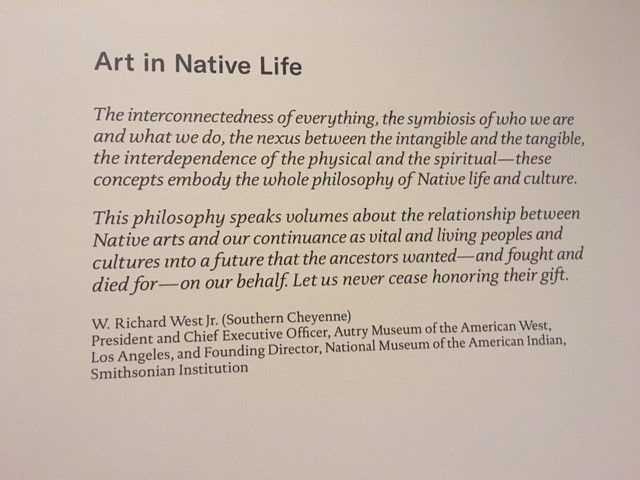
In our modern age art and culture are mainly seen as an expression of individual thought processes and in terms of the inspiration of particular artists. Yet they also were and still are expressions of the world view and values that society holds. Like the culture of most preindustrial societies outside of Europe, the culture of North American Indians was marked by an extremely close affinity to, and great respect for, nature.
It started with Winnetou …
At the age of twelve I eagerly devoured one Karl May novel after the other. What I met with there was less the original Indian culture or if it did appear it came draped in the clichés of a well read and highly imaginative German who had never set foot in America. But there was one strand to the stories that always struck me as authentic and which coloured my understanding of the Indian culture of North America from a very early age, and this was Karl May’s descriptions of the ignorant, unscrupulous and brutal ways in which white immigrants to the New World asserted their interests – power, land, gold, and then later oil.
So at the age of twelve I asked myself for the first time what had become of the original inhabitants of North America, where and how they were now living, what kind of role they played in American society and what now remained of their culture. Over the years I learnt a great deal more about this dark chapter in American history that at its heart also holds a piece of European history for the conquerors were European, as we know. I learnt about the demise of many tribes and their cultures but I also learnt about the survival of Indian traditions and wisdom in the reservations up to the present day.
Fortunately a not quite vanished culture
That in the year 2019 an exhibition on Indian art is staged in what must be the leading art museum in the USA, is, I think, a step in the direction of historical (self) awareness that’s overdue by several decades. And that it was staged by a white curator without any involvement of tribal representatives – a move that has been rightly criticised by Indians – shows that even today there is still a distinct lack of everyday, practical, effective respect for this culture. What might the exhibition have looked like if it was the result of cooperation?
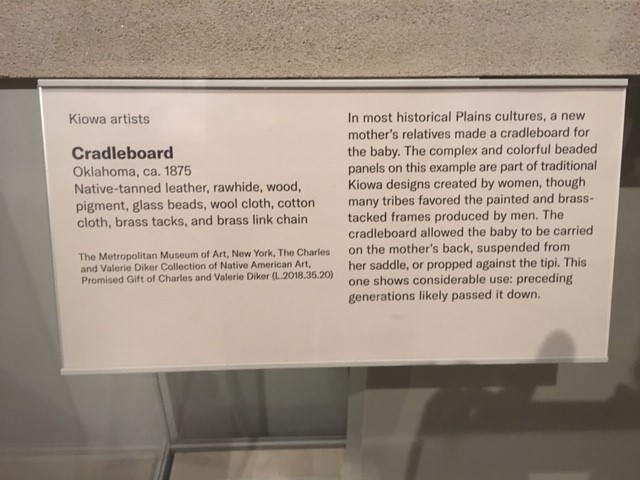
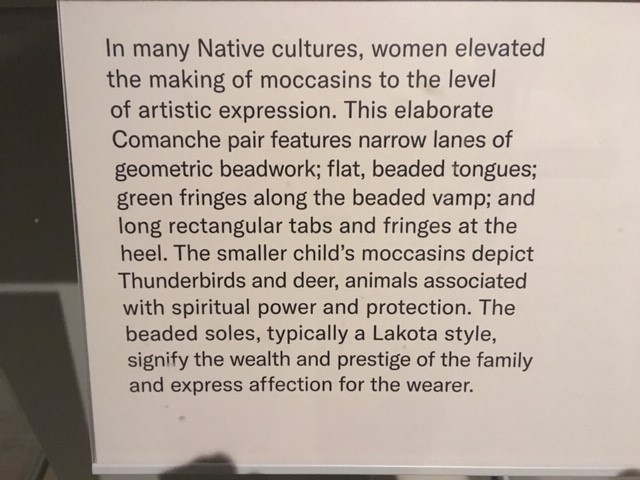
Even so, what it does show is well worth seeing. The American Wing of the museum hosts an enormous spectrum of Native American works, from superbly crafted objects for everyday use to ritual masks and cultural artefacts. The beauty and the meticulous care with which everything, particularly the everyday objects, was lovingly and skilfully crafted – baskets, quivers, shoes, jackets, clothes, slings for carrying babies – is impressive and also strangely moving as it’s an expression of a relationship not just to nature but also to time and life which we in the civilised frenzied world of the 21st century have mostly lost.
The exhibits speak for themselves. Yet I also found the explanatory texts that accompany them very revealing as they explicitly show respect for the resistance and resilience of the North American Indians in their struggle to retain their land and their culture. A culture that didn’t seek to dominate the Earth but saw itself as an integral part of it. Ruthless exploitation and depletion of its resources was inimical to the Indian culture which saw trappers shooting countless thousands of buffaloes for no other motive than their own amusement as a premonition of the demise of their own way of life.
It’s not about ‘Noble Savages’, it’s about ourselves
So whilst the UN Climate Action Summit was debating, furiously squabbling and wrangling to find arguments and money, I was getting quite a different positive take on the climate issue – in the evidence of an almost lost culture which showed planet Earth great esteem and respect – two things which it now needs more than ever.
And so, in spite of the criticism it has received, I would see this exhibition as a belated but auspicious first step, as a sign of recognition and esteem. Perhaps in ten or twenty years there’ll be a jointly curated exhibition in the main building of the Metropolitan Museum of Art which will be visited and taken seriously by far greater numbers of people than now. I, for one, would love to see it.
To prevent any possible misunderstanding let me say that obviously the Indians were not some superior kind of people. The ideal of the noble savage embodied by Karl May in the figure of Winnetou is not something I would subscribe to. Yet I do believe that Indian art and culture does contain an important message for us in our dealings with the world and all its myriad forms of life. It has to do with our consciously shouldering responsibility for what we do and how we act, a responsibility based on awareness of the complex web of interdependencies that first gave birth to us on this planet.
In my view this vital climate issue of respect for our Earth and the future of coming generations is now finally receiving the attention that industrial society has increasing denied it over the course of the past hundred and fifty years. Through the simple realisation that we are not lords of the ecosystem, merely a part of it.
“Only when the last tree has died and the last river been poisoned and the last fish been caught will we realise that we cannot eat money.” (Proverb of the Cree Indians). This iconic piece of Native American wisdom is made wonderfully tangible in the art of Native Americans. Respect.
You can find some photos of this exhibition here in the Photo Gallery:








You’ve never heard of TED? The name is an acronym for ‘Technology, Entertainment, Design’. It began back in the 80s with an annual innovation conference in California. In 2002, Chris Anderson, former editor-in-chief of WIRED magazine, took over the helm and under his curatorship TED has continually developed. For many years now the best talks have been published on the ‘TED Talks’ website where they can reach millions of people all over the world – naturally completely free of charge.
I’m always turning to this site to watch and listen to talks on a staggering number of topics – the sheer diversity of what’s on offer is fascinating. Stefan Sagmeister, the man who designed the OUBEY MINDKISS book has already appeared at several TED Conferences where one of the topics he talked about was whether design is productive of happiness. And it’s about happiness in connection with TED that I’d like to talk today.
Bad News is Good News
Because TED is thoroughly positive. Even though some of the stories told there might be disturbing or dramatic, they never end in hopelessness, but always point to a way or an idea through which a problem can be solved or a question answered.
This I find invigorating and really refreshing. Day in, day out, we’re confronted with so much bad news and so many problems in this world that you could be forgiven for thinking that everything’s just getting worse and worse. One of the main reasons for this is that old media maxim which says that only bad news is good news. Turn on the TV or radio to watch or listen to the news and you can easily get the impression that the whole world’s going to hell in a handcart.
Is that the truth though? Is it reality? Far from it. Even though that’s what many people believe. Focus on what’s positive, what’s encouraging and they’ll say that you’re denying reality. Because many people hold fast to the view that darkness in this world is growing.
Naturally far too many horrid things happen and we’re beset with problems on all sides. And yet at least an equal number of good things happen every day, and everyday problems are solved or at least are tackled in a bid to find a solution. This too is reality, even though it doesn’t get much – if any – media attention.
Development needs Positive Impulses
Development needs positive impulses. Positive impulses inspire us, encourage us, they spur us on. They release energy. And this is exactly what the TED Talks also do by showing us how much ingenuity, intelligence and courage goes into solving some difficult or seemingly impossible situation. We get to know perfectly ordinary – and at the same time truly extraordinary – people who can set examples for us to follow. Perhaps it’s an ex-president of the USA who inspires us. Or an artist talking about happiness. I myself was particularly impressed by a little African boy who wanted to protect the village herd of cows from frequent nightly attacks by lions but without killing the beasts. He hit on the idea of building a light installation which switched on at night when the lions approached and scared them away. He put this idea into action and it worked. And he showed the grown-ups in the village that you didn’t necessarily have to shoot and kill in order to protect yourself. This is why his story made such a deep impression on me. Because the effect of what he did was just as important as protecting the herd – as it led to a new way of thinking in the village. You don’t need to be powerful or rich in order to bring about positive change. You only have to have the idea and the ability and the courage to put it into practice – even with the simplest of means.
“Ideas Worth Spreading” is the subline of the TED Talks. In my view there can never be enough of such ideas. And you don’t necessarily need an internet platform to spread them. Yet TED itself is a marvellous example of a good innovative idea that helps to make the world a little bit better by showcasing the positive and giving it a voice. Perhaps you’re curious enough to drop by and give it a glance like I did all those years ago when I first heard about it. I’d be so pleased if you did!
It’s the glorious vision of leading astronomers and engineers from across the whole world. The biggest project of all time: interstellar space travel to an Earth-like planet. And it could actually be realized – in one or two centuries’ time.
How so, you’ll be asking. It’s a question I also asked myself and in trying to respond to it have come up with a whole bunch of plausible answers. From aeronautical engineers and astronomers who know what they‘re talking about. From scientists for whom precision analysis and planning is the be-all-and-end-all of everything they think and do. From the same people who, for instance, developed and built the Mars rover Curiosity and successfully landed it – fully operational – on our neighbouring planet in 2004. The people who ensured that the space probe New Horizons passed the planet Pluto on the outer age of our solar system in July 2015. Not to mention Voyagers 1 and 2. Yet all this, they say, is just the beginning.
These people are now bringing the wealth of experience gained and research results achieved in their previous work to bear on a project that doesn’t yet exist. A project in which they’ve put their hopes and their passion even though they’re well aware that they will never live to see and celebrate the accomplishment of the mission and its results.
And yet they’re still forging ahead developing concepts and finding answers to theoretical questions that contribute to the realization of such a gigantic project. Questions such as:
- Where and how should this spaceship be built?
- Who should steer the spaceship when the outward journey alone takes 50 years?
- How to accelerate the speed of a spaceship of this magnitude to that fraction of the speed of light needed for it to reach its destination planet?
- What kind of energy would be used by the spaceship that is sustainable for a period of over 50 years?
- What kind of propellant is light enough to meet this requirement? And should the spaceship be fueled?
- What kind of engine would the spaceship need?
- What kind of energy source would feed its engines?
- Where would we find such fuel?
- How can the spaceship be protected against disabling meteorite impact?
- Which redundant features are needed for the eventuality of functional failure?
- How many billions of data files does an artificial intelligence need to make it capable of steering the ship in various critical situations when the ship no longer has direct communication with the Earth.
- And last but not least: how will the ship go into reverse thrust to brake in time when it nears its destination planet. Outer space is a vacuum so there is no air resistance that could slow the ship down.
Right now physics has theoretical answers to all these questions. The problem-solving theory is already in place. If you’d like to know more about this, just watch the marvellous documentary about the Minerva project. This project is feasible. It’s just that it will take a great deal of time and require collaboration on a global basis.
If we look a little deeper into the specifics of this vision, that’s where it starts to get truly exciting. After 25 years of accelerating to a fraction (0.3%) of the speed of light, and a further 25 which the process of braking in the vacuum of outer space requires, the ship would reach the Earth-like planet, its target destination, and the on-board artificial intelligence would put out the parabolic antenna to transmit news of the successful landing back to Earth. This radio signal would reach Earth four and a half years later. From then on the artificial intelligence on-board would continue with regular transmission of scientific data back to Earth. What might happen when such a man-build spaceship lands on ‘Minerva B’, a fictitious planet similar to Earth, must be left to our imaginations for the time being.
The thought that humanity, with its present level of knowledge and know-how, can reach the next milestone in its history by leaving its own solar system and possibly discovering alien life on a planet similar to our Earth in another solar system of our galaxy is a thought that really fires our imagination.
OUBEY used to brim with such ideas when he was alive. I loved to listen to him when he talked now and then about the probability of such a venture with complete conviction that it wouldn’t take another three hundred years before such an enterprise really got off the ground. So to learn that serious scientists are already moving to bring such thoughts a whole step nearer to reality would really have filled him with enthusiasm and could well have led to new perspectives in his work had he still been alive. Ever since I recently saw the first documentary on this fictitious Minerva B project on Arte TV this idea has continued to inspire me too.
We’re living in an age in which the limited time accorded for our lives seems to revolve increasingly, and for many people exclusively, around themselves, around self-improvement, career, celebrity and money. That in such a time there’s also a special kind of people who couldn’t care less about all that stuff because nothing’s more important to them than working together with other people to help realize a vision, one that goes way beyond themselves and their own lifespans, is, in my eyes, a sign of hope for evolution. It’s simply fantastic.
No. On the very next day it became clear to me that the end of his life for me marked the beginning of a new period in which we would continue to be together but in a very different way. I accepted OUBEYs death but I wouldn’t accept that his death also meant the end of his art. Only how and through whom should his art live on and continue to work its magic? To bring an artist still unknown, an artist no longer living whose work was still to be discovered, to the light of posthumous public attention, without putting his pictures up for sale – who apart from me would be prepared to embark on such a venture? I didn’t wait around hoping that someone might turn up who would do it but answered the question myself by starting to get to work. I hadn’t the faintest idea where this first step into the future would lead me.
Through highs and lows
The first year was a rollercoaster ride of feelings. The shock sat deep. Yet the moments of great pain were followed by ever longer periods of joy as I busied myself with him and his art. And also with all those things we had done and lived through in our time together. But even when you accept the death of someone you love, you still need a great deal of time and strength of mind before you can really understand that the person you love will never again come through that door. In the time together that was given us, OUBEY was the man with whom I spent nearly every day of my life and with whom I was connected by a most intimate symbiosis.
It also helped me a lot that I never raged against fate, never asked why he had to die so young and so tragically. Such questions only lead into a dark pathless void because there never can be an answer to them.
An ending that also contains a beginning
Instead of this I was determined to do what OUBEY would have done if he’d been around to do it – which was to offer people the chance to encounter his art.
I had no idea how this would work out but I was certain that I would find a way. I knew that despite everything we would still share a common future together, at least for as long as I lived. And I was prepared to do everything within my power bring his art to the world and make people all over the world thrill to his art.
Because I was absolutely certain that an encounter with his art would be a deeply rewarding experience for people all over the world, one that would and give them great pleasure as well as some valuable new insights. So I began to travel, taking his pictures to people all over the world. It was an amazing voyage of discovery – both for the people who encountered OUBEYs paintings and for myself too. And it is far from over.
I would be very happy to have you travel with me on this very special journey – in my free e-book ‘MINDKISS. Following OUBEYs Tracks’.
Is this all just sensation-seeking showmanship, I asked myself, or is it a genuine and very special way of experiencing art. And I wanted to find out. So I recently went there and saw it all for myself.
Optical sensations – acoustic manipulation
It’s quite a long trip with the metro to get to the 11th arrondissement where the Atelier des Lumières is located. And yet so many people were making the same journey on the day I went that there was a long queue of visitors waiting for tickets in front of the entrance – even though it was 7 o’clock in the evening! Fortunately I had booked my ticket on the internet and could go straight in.
What awaited me on the inside was first of all darkness and complete silence which was astonishing given the great number of people in the hall. And then a mixture of museum and movie theatre. Pictures that the artist had originally painted with simple oil colours on comparatively small canvases now appeared as gigantic moving pictures, fragmented and seen in startling close up – a marvellous optical sensation. But with no voice-over commentary, no attempt at explanation or interpretation, just … companionable music. Now you only have to think about the power music can have over human emotions to realise how manipulative the bond between pictures and music can be – and particularly when it comes to art.
Film music is a prime case in point. Yet film music is commissioned by the film’s producers or director and so to some extent is controlled by the creators. Only here on the contrary people from the 21st century have put a musical soundtrack to the pictures painted by a van Gogh in the 19th century that the creator himself can no longer influence. An accompaniment that changes from jazz to classical music to unknown pieces with even the occasional pop song.
So it really is a genuine blend of museum and movie theatre. And this really is indispensable for this kind of presentation that could never bear the stillness needed to contemplate the original paintings themselves. Without a musical accompaniment such overwhelming optics would be simply lost in space, unable to unfurl their full intensive effects as they do here.
Now is this is good or bad?
Perhaps you’re asking yourself the self-same question at this very moment. It’s a question I asked myself. And for me it’s by no means a question of morals.
Obviously the owners of the Atelier des Lumières would go to great lengths to attract as many people as possible to their presentations and it’s pretty apparent that they’ve succeeded remarkably well.
People who are already interested in art or in this case van Gogh might well find this type of presentation of questionable taste. But there are also a great many people who shy away from the academic presentation of works of art in museums. These are the people who visit this spectacular show in the Atelier des Lumières because they’re attracted by the completely different nature of the over-dimensional digital presentation. They bring their families with them, their kids and their babies, they look around for a place in the hall, sit down and enjoy the show. If what they then see and hear gives them a point of entry to the world of art or to van Gogh and makes them curious to know more, then that in itself, I believe, is a considerable achievement. And when I tell you that the babies I saw there were completely entranced by the colours and forms passing over the walls, surely that speaks for itself.
Sensual pleasure in art not academic expertise
The Atelier des Lumières is still a young institution; the exhibition hall first opened its doors about a year ago. Klimt, Hundertwasser, art nouveau, and art deco were the themes of previous exhibitions which all used the Atelier’s 140 video projectors to project the art works on a monumental surface of 3,300 m².
The walls are 10 meters high, and with its size, its height, and the depth of the hall there’s something of the sacred about the place. It’s dark, totally dark, so that the overwhelming video projections can achieve their full effects – in some way it’s a place of awe and reverence.
And the exhibition really has reached a great many people across all ages, and all nationalities. This is not only due to the brilliance of the projections but also to their “muteness”.
There are no headsets and no museum guides whispering in your ear what you need to know or think about particular works. The Atelier des Lumières is not a place of expertise. It’s a place where in a totally unprecedented manner people can be immediately reached and moved by art. And that in my opinion is so immensely important – striking out in new directions and using the latest technology to enable an experience of art that opens up space for our own thoughts, associations and ways of seeing.
This is why I am delighted that the Atelier des Lumières is such a successful venture. It’s a fun place to be. The people there are highly concentrated, they literally drink in the pictures. And let their own sensory perceptions bathe in them.
My bottom line
This newly created opportunity for a purely emotional resonance chamber is just as interesting for the art displayed there as it is for the people who visit it. It creates a counterweight both to the commercial art world and the academic world of art. All this is fine and important. Yet as a counterweight it can only be successful if in future it also offers forms of presentation of a different nature – interactive presentations, for instance, that invite visitors to ask questions rather than just consume or even the occasional presentation whose aim is to provoke. Taking all this into consideration, the answer to the question about is this “good” or “bad” is that it’s “as much of one as the other”. Even so, I would still warmly recommend a visit – it’s very well worthwhile.
And the figures show that what I had seen in Paris is no longer the exception. The June issue of brandeins magazine tells us that 40% of British millennials now choose their holiday destination according to how well it will show up on Instagram – obviously always featuring the inevitable selfies.
The camera – an eye or a mirror?
The phenomenon of sightseeing-tourism and its banks of clicking cameras is nothing new. After all, the less time I have to familiarise myself with a place and really get to know it, the more important it is that I at least make a photo to prove that I was really there. Yet the exponential rise in the number of selfies posted on social media for me is a sign of new quality in the way we view reality, life and ourselves.
It reminds me of the story of Narcissus whose vanity was punished when he saw his own reflection in a pool of water and fell so in love with it that he became completely fixated – without ever knowing that it was his own reflection in the water so that the object of his impossible desire was simply himself. That’s the punishment. Probably very few people now know that in the ancient world self-love (narcissism) was considered a punishment. It was Nemesis – some sources say Artemis – who dammed Narcissus to such unrequited love in his reflection.
Some of the knowledge accumulated by the ancient Greeks has weathered well and at the very least is still a match for what we know now. And in this case they may even be well ahead of us since nobody nowadays would ever dream of the idea that narcissism could be the punishment for self-love. This makes the ancient story even more alluring when I think about the selfie mania we are now confronted with.
When it comes to selfies what we are doing is using the camera to see ourselves like we do with a mirror. Yet a camera, as Wim Wenders puts it so well, should be an eye, through which a person looks out onto the world.
I shouldn’t be seen by myself alone, I should be seen by EVERYBODY
Only we’ve gone a whole lot further now: we’re not satisfied with just gazing at ourselves lost in adulation, we want to share each and every one of our iconic selfies with the whole world. Yet when we do so, the world drops into the background, because the world is reduced to me. And the world is especially wonderful when I am seen by the maximum number of people who click me the greatest number of Likes. Or so the logic goes.
Of course everyone is free to do just what they want. Even so, I do still wonder from what kind of a cultural reference frame this selfie cult(ure) has sprung.
Being a star for a moment
“In the future everyone will be world famous for fifteen minutes”, said Andy Warhol prophetically back in the 1960s. He’d recognised that we’re moving into a media age when anybody can take on star allures just because they’ve made a short appearance on TV. Today, the television still has a certain role to play, but it’s the internet that enables everyone at any time across the entire globe to shout out: Hey look here, see just how cool I am and what cool things I do!
Please don’t misunderstand me. I think it’s fantastic that everyone can now share their ideas in blogs and podcasts and videos on YouTube or other platforms. It’s particularly beneficial to the great many young people whose artistic or technical gifts or skills in practical matters entertain other people or help them through the day. Earlier on, and far too often, all this knowledge and know-how was hidden away in private, ignored by publishing houses and agencies, and never saw the light of day. How good it is that things have changed!
And yet – if I’m drinking a latte macchiato somewhere in the world or eating a sushi – honestly, who on earth has really got to know this? Who’s interested? Certainly not posterity! Only those people out there just like me whose only concern is that their next selfie is better than mine and picks up more Likes. It’s the affluent society in love with itself and brazenly flaunting its lifestyle. In love with itself without recognising that this is the only love it has. Just like Narcissus.
Digital trumps analogue?
Yet whatever motives might be feeding it, one thing for sure gets lost in this rampant selfie mania: the pleasure in the passing of a lovely moment and the confidence that the best always remains embedded in our memories.
From time immemorial people have captured and preserved experiences, important events, and key figures in paintings and portraits – from the marvellous cave paintings of our ancestors over 30,000 years ago to the paintings, portraits and drawings of Dürer, da Vinci, Brueghel, Bosch and Goya. Then some 150 years ago the advent of photography opened up a host of new possibilities which are second nature for us today.
Yet when people spend a large part of their lives searching for the best selfie pose and the best selfie background, and when their eyes are permanently riveted on the display of their smartphones, they lose the freedom to seize and take immense pleasure in such moments, to enjoy them fully just as they are without any ulterior purpose. In short, here the digital world trumps the analogue.
I believe that we should use the possibilities offered us by the internet and digitalisation consciously and purposefully. But I also believe that the more we are enveloped by digital reality the more we will develop an equally strong need for experience in the analogue world. And I also have a definite hunch that our need for what’s original and what’s authentic will once more reaffirm itself. This makes me hopeful – even in times of the selfie mania.
Let’s look, for instance, at the creation of life: is it chance or destiny? Considering the vast number of sperm, the meeting of one particular sperm with the ovum must be a matter of pure chance. Yet in the microsecond that this chance becomes reality it also changes into destiny. In that moment of fertilisation destiny and chance are no longer separate entities. They become one and the same. Each living being with its entire genetic make-up, its later physical form, and its nature is created in precisely such a unique, split-second, singular, matchless and irreversible moment when destiny and chance unite to become one. Viewed from such a perspective, the questions as to where we come from, who we are and where we are going can always be given fresh answers.
It’s exactly the same with love, exactly the same with death. And exactly the same with art.
In love, in death and in art we can experience such moments of inexplicable contact between destiny and chance. If you repeatedly listen to Beethoven’s Moonlight sonata, you may sense a faint premonition of such singularity. An intimation of eternity haunts the music.
“Infinity only exists in the moment”, OUBEY once said. And even today I keep turning this insight of his over and over in my mind. Now and then, in certain privileged moments, I can grasp the deep meaning that lies in these few words. And then it’s simply the fascination of such a moment that moves me. This is not something that can be planned. It arrives unexpectedly and the fact that it happens precisely at this moment is perhaps in itself such a singular experience in which various energies coming from different directions with different degrees of force meet for one instant. Accepting such moments, savouring and enjoying them calls up in me a deep feeling of happiness which even though short-lived still resonates within me for long afterwards.
At some point destiny and chance may touch again, perhaps even in the next iteration of our being. Perhaps in the moment of our death. This is a truly beautiful thought that sounds a lot more crazy than it really is.
We humans struggle to find a word, an explanation, an order for everything we don’t understand in the hope that understanding will take us at least one step further. On the one hand, this is laudable yet on the other it’s always a misconception. And it’s an immense joy to be freed from this fallacy for a least a few short moments and to sense the real reason for all forms of being, all forms of becoming, all forms of passing away. It was such a happy moment that first gave birth to these thoughts. They make no claim to be valid. Yet in a subjective sense they are true.
And there is also a reason why I decided to publish and share these thoughts with you today of all days on 2 August 2019. It was on this day fifteen years ago, on 2 August 2004, that OUBEY, the author of the innermost thought in this piece, unexpectedly and tragically lost his life, at the age of 46, in a curious road accident. Destiny or chance? Or both of these united for a split second? A moment in which for him infinity began.
__________________________________
This picture by OUBEY was taken in a park in Aberdeen during our trip to Scotland in August 2002.
The idea to publish a book about OUBEY and his art was the first idea that occurred to me after his death in a car accident in 2004. Yet what should or could a book look like that did justice to the man and his art? It quickly became apparent that even though the idea was good and well founded, it would need time to develop. So for the time being I put the idea of a book on the back burner and devoted myself instead to exploring an approach via the internet which was a highly innovative way to take back then. I thought that with a website about OUBEY and his art I could reach considerably more people than with a book, and then there was always the possibility of interaction with all of them.
At this time by a happy chance I also met the graphic designer Stefan Sagmeister and asked him whether he could see his way to designing the internet website for OUBEYs art. His short answer was “I don’t do websites, just books” to which I spontaneously replied “I also need a book” – making him smile. So surprisingly while searching around for a web designer, one year later I came across someone who could do the book.
In blissful ignorance
Whether there really is something like chance is one of those questions that many philosophers have dealt with. In my case it’s crystal clear that my first meeting with one of the best and by now most famous graphic designers in the world wasn’t due to chance but rather to the coordinated efforts of a group of well-networked people who had gleefully organised the whole affair behind my back. They smuggled me into a group of patrons of the art travelling to New York and let me know exactly where and when this group would meet Mr Sagmeister – three days later in New York.
So there I was three days later flying to New York for the first time in my life. And when I actually met Stefan Sagmeister I still didn’t have the faintest idea who he was and what amazing work he’d already done for stars like Lou Reed, Talking Heads and the Rolling Stones – not to mention the Grammy award and all the other coveted prizes he’d picked up along the way. A true star among designers. In such blissful ignorance I just went up to him and asked. His friendly smile was a great reassurance to me.
Not yes, not no
“Before I say either “yes” or “no”, I’ve first got to see OUBEYs work. I only take on projects that I really want to do,” he said. This answer was no cause for gloom, on the contrary, it delighted me. From that moment on I knew with absolute certainty that he was the right choice for this book project. I told him that I’d be back in a couple of months with photos of OUBEYs work in my luggage. And that’s what happened.
Six months later I was sitting in his studio with a laptop full of pictures which Sagmeister was examining intently. I sensed that he found them interesting and put my question to him again. And again his answer was neither “yes” nor “no”. Instead he simply asked me, “What about five volumes in a lovely slipcase? How does that grab you?”
I was immediately thrilled. After just a short time spent with some of the pictures, he’d managed to grasp not only the diversity but the underlying integrity of OUBEYs art. Both these aspects are brilliantly and sensationally expressed in the MINDKISS book: five slender volumes showing the variety and autonomy of OUBEYs work united in a stupendous slipcase that shows that all of it is deeply connected.
An optical sensation
It took me a whole year to select the pictures for the five volumes and decide on their order of appearance in each of them. This was the basis on which Stefan and his team – particularly Roy Rub and Seth Labenz – began to work on the design. The inside of each volume was given its own colour mood while their covers in brilliant metallic silver are all the same. They even developed a special font for the book, a highly mathematical font of great transparency and lightness that was puzzling for everybody who first encountered it yet still readable. The spine of each volume bore a collection of tiny pixels which formed the name OUBEY when the volumes were placed in a certain order. My astonishment knew no bounds and when I opened a packet containing the prototype of the slipcase, I was simply struck speechless: I had never seen anything remotely comparable before.
Now that we had got so far, it was time to turn to the text.
Fancy dress for the learning process
I turned to a famous copywriter who produced a long introductory text for each volume based on what I’d told him. They were excellent texts yet I had the feeling that they weren’t quite what I had imagined for the book.
It was during a highly charged discussion that my recently deceased friend, the art critic, Annemarie Monteil from Basel, threw me a lifeline in my predicament. “You know what, Dagmar,” she said “The best parts of the text are the original quotes by OUBEY. Everything else does a disservice to art because all it does is dress it up in clothes that art doesn’t need.”
Wow, that really hit home. The text, you see, was actually finished and ready when that conversation took place. Yet I instinctively knew that she was absolutely right. And I’m someone who can, if necessary, be enough of a radical and consistent thinker to view something from a completely fresh angle. After all, better is the enemy of good.
Starting again
The texts were couched in the conventional style of art books and catalogues and talked about OUBEYs art. In other words, someone was telling readers how they had to find the pictures. Yet OUBEYs art is something that everybody has to discover for themselves. People should approach his art as free as possible from any preconceptions and not merely listen to the voice of some worthy laying down the correct way to view them.
And so it was settled: we needed new texts!
Stefan Sagmeister was a little taken aback. He even began to have doubts that the book would ever see the light of day. Yet fortunately such a strong bond of trust had been forged between us over all our years of working together that he accepted that I had real good reasons for my change of mind and that something much better was bound to come out of it. Obviously such radical decisions are not without their dangers. But of one thing I was absolutely certain: that OUBEYs art should not be described, explained or interpreted. Not in this book and not in any other production of the MINDKISS Project. And this is a principle to which I have adhered to this very day.
The end result was that each of the five volumes has only three short texts: an original quote from OUBEY himself, an excerpt from a book or a poem that meant a lot to him, and finally a short text written by myself and exclusively dealing with the background stories to the pictures.
The only way
It took another few months before the new structure for the text was fully developed – and what a pleasant three months these were for me! My odyssey of discovery of those qualities that coloured and defined MINDKISS had arrived at a juncture that gave me great clarity of vision, not just about the book.
In 2010 it was finally finished. The book was published by the Deutscher Kunstverlag in a limited edition of 1,000 numbered copies, and soon picked up three prestigious awards for the sheer quality of its design. Together with the first version of the website www.oubey.com and the OUBEY Experience film, it had its first public presentation at the ZKM Center for Art and Media in Karlsruhe on 23 March 2010. Not all of the copies have yet been sold but there will definitely never be a reprint. Like the story of the book, the book itself will remain a not-to-be-repeated one-of-a-kind.
I’m often asked whether I would ever sell one of OUBEYs paintings. And many of those people who had an Encounter with one of his pictures would dearly have liked to have kept it. Even so, as I will never sell a single one of OUBEYS paintings, and given that his pictures are seldom seen in public, the book is a way by which people can not only become acquainted with OUBEYs art but actually take it home with them.
And if one or other of its happy owners could send me the occasional photo showing it in a bookcase or cabinet or spread out on a desk or on display in the window of their shop, it would give me immense pleasure to think that the long, tortuous and highly unusual story behind the creation of this book has led to something that doesn’t merely pick up prestigious awards but is actually capable of filling people with genuine passion – quite apart from the learning curve I myself went through in the process.
At least I used to dream about flying in space when I was a kid. “Peterchens Mondfahrt – Little Peter flies to the Moon” was my favourite story. And later on like countless millions of people across the world I was fascinated and moved to tears by that legendary photo William Anders shot from Apollo 8 – of the brilliant blue globe of the Earth floating in the darkness of space. And through my meeting with OUBEY I also discovered my interest in science-fiction with its fantastic stories of manned missions to the distant depths of space and adventures of the type Perry Rhodan the hero of the sci-fi series that bears his name, used to brave. Do you also share this passion?
The fascination of the „great beyond”
Even if nowadays we know a great deal about the universe, and can explain the way it’s structured and how it was created, the view of the sky at night with its moon and stars is still something breathtakingly beautiful, something mysterious whose magnitude and grandeur we can’t really understand but which still attracts us and preoccupies us like nothing else on Earth. In places like Uluru (Ayers Rock) in Australia where the nearest electric lights are hundreds of miles away, the night sky glows with a particularly strong intensity. People who have spent the night there say that the view of such a glorious star-studded heaven was a profound soul-stirring experience for them.
It’s in such moments that we feel our deep connection with outer space. The view alone opens us up to the unconscious knowledge we receive from the heavens and give back to them. Every astronaut who’s ever been into space says that they’re a different person when they return to Earth.
And of course there’s also the curiosity to discover unknown worlds and the hunger to conquer them, to test frontiers and push them back – in our imaginations as well as in reality. At the latest since Jules Verne, the idea of leaving the Earth to land on the moon or another planet has become so overriding that it has actually been realised by people in the short space of just one hundred years. Quite unbelievable but nonetheless true.
Living in outer space
Just as explorers and adventurers once set out from the familiar harbours of Europe to sail to the New World, in future people might blast off from their home planet in search of a new home in space.
The colonisation of space is an exciting idea that OUBEY once touched on during his architectural studies in a project on “Creating the Design of a Prototype for a Space Colony”. Technical, architectural, biological-ecological, and social psychological issues were all examined from a scientific perspective, and answers given within the terms of the possibilities then available. Today the documentation of the project still makes for fascinating reading.
One of the driving thoughts behind the project was that “Through a happy chance we and a broad diversity of other life forms have taken root on this planet. And over the course of evolution we humans as a species on this Earth have taken a truly astonishing course of development. Especially during the past two hundred years we have multiplied at a prodigious rate, claiming ever more land. This is not good for our Earth. And this is the why we should leave it alone and seek a new home out there in space. What could or should this new home look like?”
What a daunting challenge this must have been to work on the realisation of such ideas!
Where our dreams lead us
Yet the step from space flights reserved exclusively for trained and selected astronauts to the possibility of space tourism is now well and truly upon us. That’s great, you might think…but is it really a cause for celebration?
Humankind has always dreamed of special places that embody our visions of an earthly paradise. And till about 70 or 80 years ago, such fantastic spots in remote corners of the world were exclusively the preserve of the wealthy with enough money to afford them. But with the advent of mass tourism, when more and more people could realise their dreams of holidaying in paradise, a reverse process kicked in which peeled the gloss from such dream destinations and destroyed them. After all, if every person dreaming of a lonely palm beach could actually go to one, then the beach can hardly be described as lonely anymore! Not to mention all the other undesirable side effects!
So for the foreseeable future a trip to the ISS will be reserved for the superrich who can afford the astronomical price tag without it making too much of a dent in their wallets. This and the fact that the ISS can only receive a very small number of visitors means that the numbers of tourists will be strictly limited. And whether this barrier to mass tourism will be removed – if ever! – is not as yet predictable. So the issue of what might happen if space tourism becomes affordable for people of average incomes is best left to science-fiction for the time being.
Our imaginations can dream up various scenarios. Would space tourism be a real advance for humankind, sharpening our awareness of the connections between the cosmos and Earth and ourselves as a species and enabling us to reposition ourselves in this cosmic order? Or would we as tourists continue to treat space just as we’ve treated all the dream destinations and tourist attractions on Earth so far?
The race for unscrupulous expansion in the terrestrial tourist sector continues unimpeded and in recent years has reached a new high water mark with the gigantic cruise liners that dominate the Laguna in Venice on a daily basis. Thousands of people are disgorged who swarm over the city for half a day and in the evening, when they’re all back on board, the floating monster moves on to its next destination. If you’ve seen the pictures, you’ll know exactly what I’m talking about.
I’ve always been enthusiastic about space exploration done by astronauts who are also experts in a range of scientific disciplines. And I still find the idea of colonising another planet in man-made space colonies truly fascinating. The great strides now being made in the development of artificial intelligence are now opening up new opportunities which just ten or twenty years ago would have been consigned to the realm of science fiction but which now present themselves as distinct possibilities. Even so, I still remain sceptical when I think of the possible side effects and consequences such a development might have, given the dismal track record of behaviour and attitudes our species has shown so far in such matters. Are we really capable of tackling these challenges we set ourselves in a way that doesn’t only take account of their technological and physical aspects but also pays heed to their ethical dimensions?
What do you think?
This wonderful, almost lyrical statement about what it means to be an artist comes from Dennis Hopper. No, not Edward, the painter, but Dennis, the film actor and director who was also an excellent photographer and a painter in his own right.
He was surely one of the most eccentric personalities that Hollywood has ever seen. He became famous for Easy Rider (1969, the first movie he directed himself, and he worked with the world’s best directors on legendary films like Apocalypse Now (1979), Blue Velvet (1986), Speed (1994) and Waterworld (1995). His provocative behaviour once nearly drove Wim Wenders and Bruno Ganz to their wit’s end until, fortunately for us all, the two actors finally managed to settle their differences after a long night of drinking.
Cinema buffs that we were, OUBEY and I shared a common enthusiasm for this great actor ever since seeing him in Blue Velvet which was the first film starring Dennis Hopper that we saw together. Two years ago and quite by chance I came across Hermann Vaske’s award-winning and very gripping documentary Uneasy Rider about the life of Dennis Hopper. The introductory quote to this blog comes from that film, and in fact it contains so many deep and meaningful thoughts about art and life and death that I’d like to share some of them with you today without any commentary on my part.
__________
Build your life according to your inner voice
Ask yourself in the stillest moments of your night: Must I write? Dive in yourself for a deep answer. And if this should be affirmative, and if you meet this earnest question with a strong >I must<, then build your life according to this necessity.
Only in itself
Everything is just station and then bringing for. To let lack impression and lack germ of a feeling come to completion, only in itself, in the dark, in the inexpressible, the unconscious beyond reach of one´s own intelligence, in a wait with deep humidity and patience. The birth hour of a new clearance. That alone is living the artist life.
Art is only a way of living
Art, too, is only a way of living. Therefore save yourself from these general things and seek those which your own daily life offers you; describe your sorrows and desires, passing thoughts, the belief in some sort of beauty – describe all these with loving, quiet, humble sincerity and use to express yourself the things in your own environment, the images from your dreams and the objects from your memory.
That´s art
I like what Marcel Duchamp once said that “The artist of the future will be a man who points his finger and says `That´s art´ and it will be art.”
The creator must be a world for himself
Perhaps it will turn out that you are called to be an artist. Then take that destiny upon yourself and bear it, its burden and its greatness, without ever asking what reckon pense might come from the outside. For the creator must be a world for himself and find everything in himself and in nature to whom he is attached himself.
To have the courage for the most strange
That is at bottom the only courage that is demanded of us to have the courage for the most strange, the most singular und the most inexplicable that we may encounter. That mankind in this sense had been cowardly, has done life endlessly harm. The experiences that are called “visions”, the whole so called spirit world, death and all those things then are so closely, attend us.
__________
Hopper´s words stand for themselves and speak for themselves. This alone would be reason enough to include them in the spectrum of my Thoughts&Insights. Yet beyond this, they also show an astonishingly close affinity to OUBEY’s own views, to his own thoughts and feelings on these issues – an affinity that instantly struck me and moved me when I first saw Uneasy Rider.
______________________________
Photo credit (Bits): Sebastián-Dario
Photo credit (Thoughts&Insights): OUBEY – Summer Day
The article in Monopol Magazin was based on the rather dispiriting experiences made by its author Oliver Koerner von Gustorf at this year’s biennale. But it could easily have been talking about the whole of the present-day’s commercialised art scene.
Decadent and self-centred
He details and criticises the whole system, from the works on exhibit to the art-makers, managers and potential buyers. Vapid works of art that say nothing but pretend to be meaningful to justify the astronomical prices at which they change hands. Works that even if not for sale are at least eye-catchingly sensational and thus serve as extremely effective PR for the artists and their gallery agents. And form a perfect match to the codes, conduct and attitudes of the players of the established art world.
They meet up at all these more or less important events and swell with self-importance at each visiting card they hand out. The biennale as a mere stage for pseudo-intellectual self-presentation. The art scene as a closed society. An exclusive celebration of decadence.
There’s a lot of truth in this but really little that’s new. It’s a trend that has been in full swing for the past thirty years now, one that’s clearly recognisable by every unblinking critical eye that’s impervious to its poisoned blandishments. And it was precisely his acute awareness of such mechanisms that made OUBEY turn his back on the system after his first and highly successful sales exhibition in 1992. It was a very wise move.
An air of exclusivity
The whole system in its present form is only of interest to insiders – in other words the few who live within it and profit from it. I can only agree with the author of the article when he writes, “In the established art world the same rules apply to people that apply to the commodity of art. In one way or another they have to have an air of exclusivity, otherwise the system won’t work.”
And I also agree with Elke Buhr, editor-in-chief of Monopol Magazin when she says, “Modern art is nothing less than what the art system presents as art. Works that have no label, that aren’t on display in some gallery or other, that aren’t part of an exhibition, that don’t bear the signature of some famous artist, are not considered as art.”
It’s interesting – and also rather paradoxal – that a magazine such as Monopol also forms part of the very system it so vehemently criticises. The question begging to be asked here is, does such insight also lead to self-awareness? And if it does, what consequences should be drawn? Or is such a blast of unanimous criticism an end in itself so that after everyone’s shaken their heads in doleful agreement at just how awful the art world really is, they all return to business as usual?
Banksy undercover
I rather suspect that that’s exactly what they do.
The art scene operates for financial benefit. Now there’s nothing intrinsically wrong with this. Yet one of the side effects is that it is the instance that decides what is true significant art and what is not. Works that can’t be sold for astronomical prices are uninteresting and fade into insignificance.
Such a system would have to self-destruct before it could recognise that living art has long been thriving outside of the “sacred halls” of the established art world. Sometimes it even crops up directly next door to them – as was the case at this year’s biennale.
Banksy, the greatest street artist of our times, took the biennale as an opportunity for his latest action. He set up his own stall with pictures on the side of one of the canals and not one of the art experts realised that Banksy was there. This says more than a thousand words and shows just how startlingly blind they are to living art that takes place outside of the closed world of the art business. How dearly they would all love to assimilate this intractable artist and make him a player in their own game – the man whose works are auctioned for fantastic prices. Yet Banksy does his utmost to ensure that they never will. He won’t let them put a price tag on his success. Shunning the system, yet at the same time brilliantly exploiting its treacherous mechanisms, he’s forged his own way to celebrity.
There are many people who make or have made art just as fascinating as Banksy’s. Yet none of them are as world-famous as he is. But that’s not the point. The point is to bring art into people’s lives in the places where they actually live, to inspire them, to make them think or to move them to action, or simply to give them great pleasure. It’s this unfiltered joy in art that is so special and we must never allow anything to get in the way of it – certainly not a biennale in Venice. That’s what I think. What about you?