
Thoughts & Insights
Stories About the Sparks in the OUBEY MINDSPACE – Episode 13: Like Tears in Rain
What makes a human being human? What distinguishes humans from Artificial Intelligence? Some of the most insightful science fiction writers have been grappling with this question for many decades.
Again and again, some of the genre’s greatest works have offered strikingly similar answers. Think of Isaac Asimov’s I, Robot, Arthur C. Clarke’s 2001: A Space Odyssey, or Philip K. Dick’s Do Androids Dream of Electric Sheep?
In essence, the answer is this: It is not intelligence that distinguishes humans from artificially created beings. It is their capacity for empathy.
In the fall of 1983, when OUBEY and I had not known each other for very long, we went together to a movie theater in Karlsruhe to see Ridley Scott’s Blade Runner, based on Philip K. Dick’s novel Do Androids Dream of Electric Sheep? I wasn’t familiar with the novel at the time.
Until then, my own exposure to science fiction literature had been limited to H.P. Lovecraft’s At the Mountains of Madness. I had read the book a few years earlier on a mountain plateau in the French Alps—a rather fitting setting for that particular read.
OUBEY, on the other hand, was right at home in the world of science fiction. From the age of twelve, he had been a regular reader of the weekly serialized novels in the Perry Rhodan series. By the time I met him, his collection of science fiction novels was already impressive.
Part of this library changed hands in an unusual way in the summer of 1985.
At that time, OUBEY met the Czech Ondřej Herec, a passionate science fiction fan. Herec was responsible for international cultural exchange in the field of amateur and small-scale theater at the Czechoslovak Ministry of Culture. As a Communist Party official, he was accompanying the GAG theater group from Bratislava, which was performing at the international Sandkorn Theater Festival in Karlsruhe. Somehow, their paths crossed there.
When Ondřej later visited us at our apartment and discovered OUBEY’s vast science fiction library, OUBEY didn’t hesitate for a moment. He gave him the novels Ondřej had been eager to read but could hardly get his hands on in former Czechoslovakia. When Ondřej left our apartment, his bag was filled to the brim with science fiction novels.
A small gesture—and yet one that says a great deal about OUBEY. Empathy over Ideology
Politically, things could hardly have been more different. OUBEY fundamentally rejected totalitarian systems such as those still prevailing in Eastern Europe at the time. Yet in that moment, he apparently didn’t see the party official, but rather the person who shared his passion for science fiction and who, because of the political circumstances, did not have the freedom to read the books he wanted to read.
After the end of Soviet domination in Eastern Europe, Ondřej Herec became known in Slovakia as a prominent sociologist and a founder of literary science fiction theory.
In November 2013, as part of my Global Encounter Tour, I exhibited eight original paintings by OUBEY at the Peter Drucker Forum’s international management conference in Vienna. Ondřej, who was already seriously ill at the time, traveled to Vienna accompanied by a nurse so that he could see these paintings. He was impressed by their expressiveness and deeply moved by this spiritual reunion with OUBEY.
Almost thirty years earlier, OUBEY had opened his library to Ondřej; now, in his own way, Ondřej was returning that gesture of empathy.
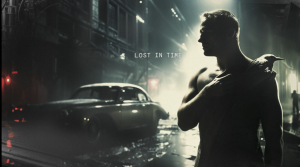
For OUBEY, Blade Runner was one of the best science fiction films ever made. And he had regarded Ridley Scott as one of the outstanding directors of his time ever since Alien.
One of the film’s major unanswered questions is: Is the android hunter Rick Deckard human—or is he himself a replicant? The film offers no clear answer until the very end.
And then there is Roy Batty. The replicant, facing his own death, sits on the roof of a skyscraper in the pouring rain. In his famous monologue, he recalls experiences, images, and moments that a human could never have experienced—and that will vanish irretrievably with his death.
“I’ve seen things you people wouldn’t believe. Attack ships on fire off the shoulder of Orion. I watched C-beams glitter in the dark near the Tannhäuser Gate. All those moments will be lost in time, like tears in rain. Time to die.”
Ironically, it is the supposedly artificial being who, at this very moment, displays something profoundly human: the ability to remember the past, to accept his own death—and to let the other live. He could kill Deckard, but he does not.
Deckard watches the android die and, in doing so, recognizes his humanity. The supposed human appears less human than the supposed non-human. Perhaps it is precisely in this blurring of seemingly clear boundaries that one of Blade Runner’s most powerful ideas lies.
If one were to condense the answers of the great science fiction writers to the question of what distinguishes humans from artificial beings into a single word, “empathy” might well be the term of choice.
Intelligence alone is not enough to explain humanity. Machines can calculate, recognize patterns, learn, and solve increasingly complex problems. But what does it mean to truly grasp another being’s situation? To feel compassion? To show consideration? To feel respect—not only toward other people, but toward life itself?
It is possible that artificial intelligence may one day be able to feel and act “humanly,” just like the android Roy Batty in Blade Runner. One thing is certain, however: humans are certainly capable of acting in very inhuman ways. They have proven this time and again throughout their long history. Perhaps the line between what we call intelligence and what we experience as humanity is less clear-cut than we would like to believe.
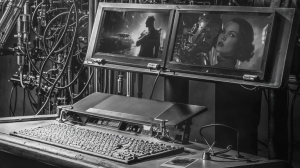
The “Tears in Rain” passage in OUBEY MINDSPACE can be understood, on the one hand, as a reference by OUBEY to Ridley Scott and his cinematic masterpiece Blade Runner. At the same time, it points to the significance that OUBEY himself attached to emotion. He once described it in the following words:
“The feeling is like a rubber band, a springboard, a slingshot. The greater the space in which the feeling can develop, the better.”
The conversation in which he made this statement in 1992 was recorded at the time. That is why we can still hear it today in OUBEYs own voice, in this Spark from OUBEY MINDSPACE. Here´s the link to the “Metropolis Room” where you find this Spark.
There are six rooms in OUBEY MINDSPACE. Each contains five different Mind Sparks, which in turn contain various impulses. Behind every Spark and every impulse lies a story about OUBEY and what interested and inspired him. I’ll be telling these stories here.
I’d like to take this opportunity to thank the team at Kubikfoto³ for their outstanding design of OUBEY MINDSPACE, which has already received three prestigious international design awards—most recently the 2025 Red Dot Award.
 ;
;
 ;
;
Share