
Thoughts & Insights
Stories about the Sparks in the OUBEY MINDSPACE – Episode 14: Time
“What, then, is time? If no one asks me, I know what it is. But if I want to explain it to someone who asks, I don’t know.” Augustine
Time passes more slowly in the universe than it does on Earth. We have known this ever since Albert Einstein published his General Theory of Relativity in 1915.

We also owe to him the insight that the distinction between past, present, and future is nothing more than a persistent illusion. The fact that this illusion has nevertheless become so deeply ingrained in the human mind does not change the fact that it is based on a misconception.
What we see when we look up at the starry sky at night is a view from the present moment into the past of our universe.
Films such as Christopher Nolan’s Inception, Interstellar, and Tenet explore the concept of nonlinear time in fascinating and inspiring ways. I would love to watch these films together with OUBEY one day and hear what he has to say about them. Sadly, that is no longer possible in this lifetime.
Today, we know a great deal about time. And yet it remains a mystery to us.
Some people believe they can solve this mystery by stripping time of its magic and reducing it to what the hands of a clock or the pages of a calendar tell us. Someone born fifty years ago may, biologically speaking, be ten years younger. Nevertheless, we go by the date recorded on their birth certificate.
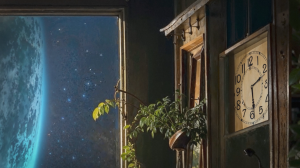
Our regulatory, chronometric approach to time imposes the same measure on everything. This certainly has its practical advantages. It gives structure to our days, creates order, and prevents chaos in global business and air traffic across the different time zones of our planet.
OUBEY’s attitude toward the regulatory and chronometric function of time was characterized by an almost total disregard for it. In this respect, he was probably not unlike many other artists. Time was freely available. A painting or a piece of music is finished when it is finished. That may happen quickly. But it may also take weeks, months, or even years. Sometimes a work remains unfinished. Its value is not measured by the amount of time it took to create, let alone by the sums of money wealthy people may be willing to pay for it.
We know that Thomas Mann followed an almost painstakingly precise daily routine, with dedicated writing time firmly built into his schedule. This helped him avoid the danger of drifting aimlessly and without structure through his days, only to find at the end that he had created nothing of what he might have achieved. This disciplined approach to work enabled him to produce a literary oeuvre that would eventually earn him the Nobel Prize.
And there are stories about successful gallery owners who, once artists sign with them, require them to deliver a certain number of saleable works each month or quarter.
For OUBEY, one approach was just as unthinkable as the other. The idea of working according to a timetable would never have occurred to him. Drawing and painting were an integral part of his life. He was free to decide how to spend his lifetime, and he made full use of that freedom. He did what he loved, what interested and inspired him.
Love and art have the power to free us from the dictates of time. Art is free in the artist’s individual creative expression. But it also transports those who open themselves to it into a state of timelessness that is as strange as it is wonderful. Who would ever think about time while listening to Debussy’s Suite bergamasque or Beethoven’s Moonlight Sonata? And who thinks about time when doing something they truly love?
OUBEY had his own rhythm of life and work. Accepting that never seemed difficult to me. Despite my professional commitments, which involved a very different daily rhythm, we always found enough time together for the things that mattered to us and that we most enjoyed doing together. I am very glad we managed to make that work so well. To this day, I have never felt that we missed out on anything essential to life.
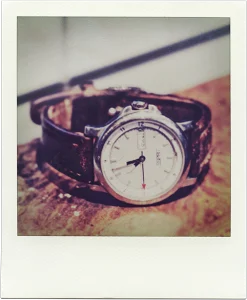
At some point, he began wearing a wristwatch. That is why it is one of the twelve artifacts to be found in the MINDSPACE. It made it easier for him, in turn, to adapt to my rhythm of life. In the evenings, when I came home, we could cook and enjoy a meal together, often something he had already prepared, and have wonderful conversations along the way. Gradually, he developed a real appreciation for beautiful watches, especially those crafted with exceptional skill and craftsmanship. His attitude toward time itself, however, never changed:
“You don’t have time. You make time for what matters.”
After his first highly successful sales exhibition in 1992, he was faced with a difficult question: Should he give in to the temptation to follow a path that promised commercial success, or listen to his inner voice, which was warning him against doing exactly that?
“If I keep going like this, I’ll lose the source of my art,” he told me at the time.
It was a decision of existential importance for his future as an artist and, not least, for the way he would spend the time he had been given.
“Give yourself the time and freedom you need to create the images that take shape in your mind,” I told him. “No matter how long it takes, you’ll know when you’re ready. Until then, only one thing matters: that you never stop working.”
And that is exactly what he did. For twelve years, with remarkable consistency, growing increasingly confident in himself and his path as time went by. Until his lifetime came to an abrupt and unexpected end.
To this day, I am deeply grateful that he chose that path. Works such as GENESIS and the StarPixel project could only have come into being through the freedom he claimed for himself and gave himself at that decisive moment in 1992.
Those twelve years of withdrawal from public life were not a loss for him. They were a gain in time – time well spent, in the truest sense of a life lived.
Measured chronometrically, OUBEY and I spent twenty-one years together – the greatest gift of time I have ever received. But in reality, our time together is by no means over. It is still continuing. Not only through my work on and for the MINDKISS project, which is dedicated to his art and, through it, to him. But because love transcends the boundaries of time and space.
P.S. Inspired by a report from a polar researcher about the absence of time at the North Pole, I wrote an article titled Where Time Has No Meaning long before there was a Spark on this subject in the MINDSPACE. Perhaps today’s story has made you curious enough to read it?
Where Time Has No Meaning – OUBEY MINDKISS
The OUBEY MINDSPACE consists of six rooms. Each contains five different Mind Sparks, which in turn offer a variety of thought-provoking impulses. Behind every Spark and every impulse lies a story that tells us more about who OUBEY was and what he was like. These are the stories I share here.
With thanks to the team at Kubikfoto³ for creating the OUBEY MINDSPACE, which has by now received three international awards, including the prestigious Red Dot Award.
 ;
 ;
Share